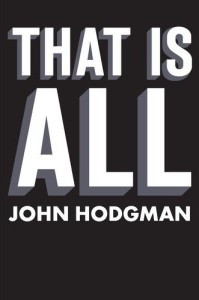
That is All
by John Hodgman
[Book]
view/request
Previously I reviewed John Hodgman’s The Areas of My Expertise, his first volume of complete world knowledge. Now, I’ll take a moment to give more of the same praise to the third and final installment, That is All. Again, Hodgman provides fake historical information and hysterically terrible advice (including the necessary tools to become a deranged millionaire). In addition, he continues the page after page factoid calendar that appeared in More Information Than You Require; only this time he decides to predict the FUTURE right up to the coming apocalypse scheduled for December 21, 2012.
That is All is a magnificent read.
Reviewed by Jason
Tagged: Comedy, Fiction, Trivia
Wild Flag
by Wild Flag
[Music CD]
view/request
Dear Reader,
I would never lie to you. And when I say to you that I like to rock, I hope you understand that what I am saying is an absolute truth. Wild Flag’s self-titled debut album is what rock n’ roll ought to be: loud, fast, played live and without a lot of fuss. This supergroup features ex-members of Sleater-Kinney, The Minders and Helium. What stands out most to me musically is Carrie Brownstein’s (of Portlandia fame) blistering riffs, the spirited drums fills of Janet Weiss and the harmony sound the four vocalists create. The stellar musicianship of this bassless, garage rock quartet often propels these excellent songs into uncharted territory.
Just a couple examples for you… The lead off track “Romance” has some reverbed out surf overtones and a chorus that can’t help getting stuck in your head. On “Glass Tambourine”, the group certainly draws from the Nuggets archives, but then moves into a spaced out heavy jam that the late Jimi Hendrix would certainly appreciate.
I love this album and that’s a fact!
Sincerely,
-JSM
P.S. Please enjoy this music video directed by Tom Scharpling.
Reviewed by Jason
Tagged: Music, Pop music, Rock music
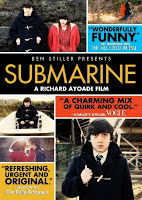
Submarine
by Richard Ayoade
[DVD]
view/request
Olivier Tate (played by young actor Craig Roberts), the protagonist in Richard Adoaye’s quiet, quirky, charming, dark and thoroughly enjoyable film Submarine is a likeable precocious Welsh boy searching for an identity and direction in the stifling climate of small town coastal Southern Wales. He tries on affectations:”I’ve tried smoking a pipe, flipping coins – listening exclusively to French crooners, I’ve even had a hat phase”. This quote is immediately followed of course, with a shot of him at the family dinner table, wearing a Blue Stetson, looking fairly ridiculous. His teenage flailing about for identity finds its focus when he discovers the dark and indifferent charms of classmate Jordana (Yasmin Paige), who lures him into more and more morally reprehensible schoolyard acts. She is outwardly resistant to his charms except when he is misbehaving, and seems most allured by his taking part in the bullying of a fellow school girl. The cast is fantastic, both Paige and Roberts inhabit their roles fully and believably, while the adult characters (Sally Hawkins and Noah Taylor as Olivier’s parents), are comically stuck in their own lazy unspoken despair, too wrapped up in their own ridiculous melodramas to offer guidance to Olivier. Paddy Considine appears as an almost incongruously broad comic foil and rival to both Olivier Tate and his father. Adoaye, most famous for his work on the UK sitcom “The IT Crowd”, who adapted the script from a novel by Joe Dunthorne, directs the film with care and fills it with beautiful shots of the beaches, woods and amusement parks of the Welsh Coast. There are aspects of the film’s plot, details and cinematic style which will appeal to fans of many other refreshingly offbeat comic films (Wes Anderson’s films in particular) but the unique characters, acting performances and Welsh character give it a charm all its own.
Reviewed by Dylan
Tagged: Comedy, Drama, Feature film, Fiction, Romance
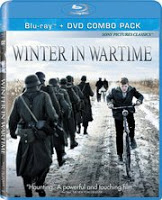
Winter in Wartime
[Blu-ray, DVD]
view/request
This beautifully shot period film follows 13 year old Michiel, a small town boy in Nazi-occupied Holland in the Winter of 1945. Michiel’s childhood innocence and restless desire for adventure lead him into increasingly dark and morally ambiguous territories when the realities of war, resistance and adulthood collide and converge upon his small town life. He is apprehensive about his father’s uneasy cooperation with their German occupiers and looks up to his uncle Ben, a resistance fighter whose connections, gifts and attitude intrigue Michiel. When an allied fighter pilot crashes near the village, Michiel and his sister, a young nurse, are drawn into the search for the pilot and must debate whether to take action or remain silent, and question who they can truly trust. The film, while somewhat conventional in some of its WWII era plotlines, offers enough twists and intrigue to keep the viewer’s attention, but its real appeal is grounded heavily in the films setting. The scenes are filmed beautifully and the village, woods, snow, bicycles, knitwear and natural light combine to give the film an enchanting sense of place, and ground the viewer in Michiel’s conflicted world, caught between action and fear, occupation and resistance and childhood innocence and the risks of adult responsibilities. This film is one of several Forbes films now added in Blu-Ray and DVD (both discs are included in one case, so patrons will not mistakenly get home and find the film unplayable), and the Blu-Ray is especially recommended for its crisp picture, which captures the film’s setting wonderfully.
Reviewed by Dylan
Tagged: Drama, Feature film, Foreign film, Historical fiction, History
Talking Tabla
by Bikram Ghosh
[Music CD]
view/request
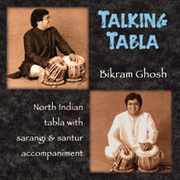
Talking Tabla is an exciting recording showing off the work of a masterful tabla player. The tabla is a popular Indian percussion instrument, and is ubiquitous in the classical music of Northern India. The tabla consists of two hand drums of contrasting designs: on the left is a kettle drum with a deep sound and variable pitch; on the right is smaller conical drum with a high, fixed pitch. The drums are struck with the fingers and palms of the hands to create the sounds known as bols, these are the syllables of North Indian drumming and can be spoken as well as played; well performed, they sound very much like language, hence the title of this album, Talking Tabla.
On Talking Tabla Bikram Ghosh plays a variety of compositions, fixed and improvised, in a variety of styles, including a piece in the less familiar Carnatic style of South India. Although Bikram Ghosh’s tabla is the focus of these recordings we are not deprived of melody—Ramesh Mishra does a beautiful job playing the sarangi (a kind of elaborate fiddle) on several tracks and on the third track Ghosh accompanies Tarun Bhattacharya’s santoor (hammered dulcimer). In addition, Ghosh’s beautiful baya (left hand drum) application creates a kind of melody of its own. (To fully appreciate this a pair of good speakers or headphones are recommended—don’t listen to this one through your laptop speakers!) Even those who are bored by the idea of an album devoted to the drums should consider listening to Talking Tabla.
Reviewed by Ben
Tagged: Drums, Folk music, Indian music
Maphead : charting the wide, weird world of geography wonks
by Ken Jennings
[Book]
view/request
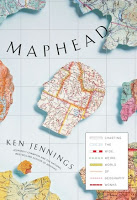
I like maps, I like geography and I mostly liked this book. Ken Jennings’ book had many interesting stories to tell; my favorites being the sections on early cartography, the London Map Fair and the National Geographic Bee. He lost me however with the couple of chapters devoted to GPS (games and navigation) and geocaching. I was disappointed that I did not love this book in its entirety but would recommend it nevertheless because of the author’s informative and witty writing.
Reviewed by Susana
Tagged: Geography, History, Maps, Non-fiction
The Glasgow School
by Orange Juice
[Music CD]
view/request
File this one under “neglected”.
Due to odd sizes of items, value, age, et cetera, we sometimes have material here at Forbes that lacks a certain “browseability” or just isn’t given an ideal sight line. The Glasgow School certainly falls somewher under this category. This cd, filed with our boxed sets because of its book bound style case, may be a little off the radar for our casual music browser.
Orange Juice, fronted by Edwyn Collins, was a group that successfully meshed clever, highly literary lyrics with danceable musical accompaniment. The songs on The Glasgow School collects the band’s first singles and outtakes. These sessions sound more rough around the edges than the slicker produced records that followed. Collins’ romantic, baritone voice handles the majority of the lead singing with James Kirk interjecting some gems here and there (Kirk would leave OJ after the release of the classic full length debut You Can’t Hide Your Love Forever).
Here we have inspired music from Scotland at the start of the 80’s representing the lighter side of the post-punk era. Lyrically, they match wits with the best. Collins laments in Blue Boy “Oh curse and bless him with the gabardine which surrounds him/See him writhe at the sight of your eyes which repel him”. Their lasting influence is easily heard throughout the catalogs of the Smiths, Belle & Sebastian, Franz Ferdinand and hopefully, if people can find Orange Juice, many more musicians to come.
Reviewed by Jason
Tagged: Music, Post punk, Rock music
Doctor Who: The Awakening
[DVD]
view/request
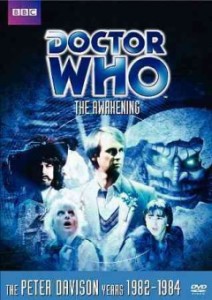
Peter Davison stars as the Doctor with the cricket inspired get up and celery stalk fastened to his lapel. You’ll have to wait until Davison’s last appearance however to learn the purpose of the mysterious vegetable! Regarding this particular shorter story, the Doctor promises to reunite his companion Tegan with her grandfather in her present time of 1984.
If it were only that simple…
When they arrive at the quaint village of Little Hodcombe, they are greeted by people with long flowing beards in suited armor on horseback. The Doctor and his companions are led to believe the townspeople are taking part in some sort of reenactment of a famous civil war battle from 1643.
We soon discover that they have actually landed in a time parallel between the years 1643 and 1984 due to an underground beast who is also warping the minds of Little Hodcombe’s citizens and projecting humans from the 17th century in their reality. Confused yet? Check it out for yourself and enjoy this entertaining two-part Doctor Who adventure.
Reviewed by Jason
Tagged: British TV, Science fiction, TV series
The Night Circus
by Erin Morgenstern
[Book]
view/request
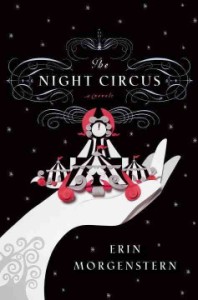
Evocative. Descriptive. Atmospheric. The Night Circus is a good story, but its the atmosphere that will keep you turning the pages. Set in the late Victorian era, The Night Circus tells the story of two students, Celia and Marco, forced by their individual teachers to compete against each other in a game they don’t understand. Their playing field is an unusual circus, which becomes more and more fantastic as the two young magicians populate the circus with their increasingly elaborate creations. A carousel with strikingly realistic animals. A tree without leaves or flowers, but covered with candles which never go out or melt away. A hall in which hundreds of mirrors each show something unexpected. A garden made of perpetually unmelting of ice.
Everything about Le Cirque des Rêves is improbable, and much of the book is devoted to describing the circus and the experience of visiting it. The narrative shifts in time, place, and voice, but always describes the circus or the people connected to it. Some chapters are written in the second person, and while most of the book is written in the third person some chapters are completely without characters (unless you count the circus itself); these chapters especially create a feeling of immersion and they felt to me as if they were in the second person, even if they did not use the word “you”.
The level of detail is appropriately, but sometimes startlingly, varied. Morgenstern often writes at length about minutia such the smell of the popcorn, or the costume of a particular performer, only to gloss over the details of a conversation in the most general language. These glosses may, perhaps, represent some lost opportunities on Morgenstern’s part, where she could have further fleshed out her story, but on the whole I found them unobjectionable and even welcome; not only did they help keep the story focused, but they contributed to the tone of the novel, which I found unusual but very much enjoyed.
The Night Circus is a fantasy, and a romance of sorts, and will be enjoyed by many open-minded readers of both genres.
Reviewed by Ben
Tagged: Fantasy, Fiction
Let’s Spend the Night Together
by Hal Ashby
[DVD]
view/request
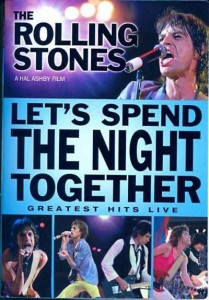
I remember watching the Rolling Stones in Let’s Spend the Night Together a few times on television when I was in high school. I know this sounds unbelievable, but VH1 used to show concert films and was actually a music station back in the day. Maybe I couldn’t get behind the 1981 renditions of the classic 60’s tunes at the time or was distracted by Mick Jagger’s football tights … truth is, I didn’t really dig the concert film when I first watched it.
Fast forward to last night. I popped in this dvd for nostalgia sake and wound up really enjoying myself. The performances are unbelievable! In addition, I made the statement to my friend who was sitting next to me on the sofa that “this just might be the best Stones concert film ever.”
The boys barrel through 24 songs in under 90 minutes with the right blend of machismo and camp that we expect from the band. Despite playing a huge stadium, they’re very, very loose with unexpected bendy guitar riffs distributed throughout by Ron and Keith , jazzy drum fills care of Mr. Watts and Mick’s wild singing. If you look close enough, you may even see a smile on Bill Wyman’s face, too. Some of the older songs appear to be unrehearsed to a certain extent while more recent cuts from Tattoo You, Emotional Rescue and Some Girls are played tight like a classic rhythm and blues review. We’re also treated to a bonus keyboard section featuring Ian McLagan (of the Small Faces & Faces fame) sitting behind the organ and classic stones session man Ian Stewart on piano.
It’s also important to note that a serious filmmaker was on staff for Let’s Spend the Night Together. Hal Ashby, whose credits include Harold & Maude, The Last Detail, Being There and many other fantastic titles, directed the film. It’s always interesting to see the difference between a standard concert film and one that was overseen by a true artist. Martin Scorsese’s work on the Last Waltz and D.A. Pennebaker’s Montery Pop are other excellent examples. They tend to spend more time with the performers and not make pointless quick cuts. There is something to be said in what these filmmakers find interesting and insist the audience see on stage.
The real lesson learned however is that it doesn’t hurt to revisit films you may not have enjoyed at one stage in your life. You never know in what direction your taste may take you.
Reviewed by Jason
Tagged: Classic rock, Concert film, Film, Live recordings, Rock music
Kansas City
by Robert Altman
[DVD]
view/request
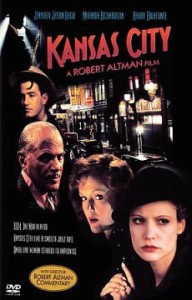
It’s 1934 and on the eve of a local election in Kansas City, Missouri.
Jennifer Jason Leigh stars as Blondie, a comically fast talking wife of a petty thief. When her husband gets picked up by an intimidating local jazz and gambling club owner stroke gangster named Seldom Seen (played by the great musician and activist Harry Belafonte), Blondie hatches a kidnapping scheme of her own. At gunpoint she drags Carolyn Stilton, the opium addicted wife of a local senator, along through the city in an attempt to free her husband. Miranda Richardson and Altman mainstay Michael Murphy are cast as the seemingly loveless Stilton couple.
Tension enters the film only moments after it begins and it continues to build and build throughout. The backdrop of this chilling drama is the soulful and swinging jazz music that pulsates from Seldom Seen’s Hey Hey Club. In addition, Steve Buscemi, in a role that seems to have served as a warm up for his stint on Boardwalk Empire, is one of the many actors who appear in memorable smaller parts.
Kansas City, though not as loose and off the cuff as many classic Altman movies of the 1970’s, is possibly the director’s most suspenseful.
Reviewed by Jason
Tagged: Drama, Feature film, Jazz
Day For Night
[DVD]
view/request
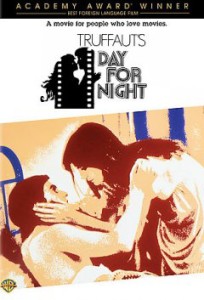
La Nuit Américaine, or Day for Night, is one of my favorite films. This 1973 film by French director François Truffaut shows the cast and crew of a dramatic film on and off the set. In addition to the obvious work necessarily to make a film—selecting costumes and props, learning lines, building sets, performing for the camera, adjusting lights, etc.—we also see these men and women as they make friends, suffer nervous breakdowns, fall in love, gossip, run away, return, and otherwise live rather complicated lives.
The film stars Jacqueline Bisset and Jean-Pierre Léaud as the film within the film’s young stars, but the film truly has an ensemble cast, with many talented actors portraying a wide array of interesting and memorable characters. Truffaut himself is part of the cast, as he not only directs the film, but also plays the director of film within the film. The music is by Georges Delerue, who also worked with Truffaut on a number of other films.
Reviewed by Ben
Tagged: Drama, Feature film, French language