Louis C.K. : Hilarious
[DVD]
view/request
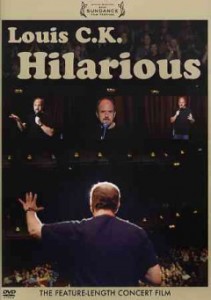
If you are easily offended by delicate or obscene subject matter, this 2010 concert film is, clearly, blatantly, spectacularly… not for you. Come to think of it, if you are offended by ANY words, in and of themselves, regardless of context, you may want to look elsewhere. It’s not that Louis is un-necessarily mean spirited or seeks to offend (well, except that he admittedly is and does, admitting at one point herein that shocking people makes him laugh) but he will leave many people squirming in their seats, probably laughing inside, but uncomfortable, to be sure. To those that love Louis C.K. , and I count myself strongly among them, his latest hour is the pinnacle of years of discipline and work on the road . It is the first Stand-Up film ever to be accepted at Sundance and the first stand-up comedy film in decades to show in theaters.
Unlike most working comics, Louie has been creating a completely new hour of stand-up every year, abandoning all older material, testing new routines every spring and summer in clubs and theaters before filming an hour special when his new hour is fully developed. Despite the obvious shock factor in many of the bits, what makes his comedy work so well is the surprising heart and thought that go into the writing, and the natural, “I just thought of this and I’m going to share it with you” delivery . When you are watching Louis perform at his best, you see the exasperated self-loathing character he describes and believe in it fully, to the point where you forget that he performs the act night in and night out, and it can be unsettling to see the same joke performed again elsewhere. Much of the best material he has used in his last few specials have been inspired by his role as a devoted father of two daughters and the experience of his recent divorce. When he delivers lines about the ridiculous anger and exasperation many parents feel but never openly express, it is always obvious and without question how much he loves his own children. While he brilliantly and savagely mocks the stupidity and spoiled impatience of modern day America, he saves his strongest contempt for himself.
The best stand-up is often that which lays bare the desperation and pain of our brief and ridiculous moment on earth and allows us to laugh at the most fragile and childish of our own instincts. At its best this film recalls some of the finest moments of his heroes, Pryor’s ability to make us laugh at his most painful moments and Carlin’s ability to dissect the absurdity of his time and make us see and laugh at ourselves. The film, however, is 100% Louie, and is the painfully funny work of a stand-up at the height of his powers.
Reviewed by Dylan
Tagged: Cell phones, Comedy, Divorce, Fatherhood, Obscenity, Parenting, Stupidity
Wheel of Time
by Werner Herzog
[DVD]
view/request
Werner Herzog, director of Fitzcarraldo, Aguirre: the Wrath of God and Stroszek, has almost become equally as famous for his non-fiction work in recent years thanks to the success of the fabulous Grizzly Man documentary. Forbes Library is fortunate to be receiving several of Herzog’s documentaries (many of which currently hard to find, out of print titles) through our acquisition of the Pleasant St. Video collection thanks to the kind donations from our patrons.
I first saw Wheel of Time at a Werner Herzog retrospective in Austin, TX. I must confess that I didn’t know much about the film or this German auteur at the time. I would soon receive a wonderful education by purchasing a pass to attend the rest of the festival and also borrowing everything I could find by the director at the video library where I was then employed.
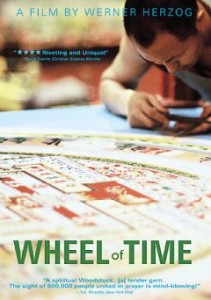
The film chronicles a Buddhist pilgrimage to Bodh Gaya, India. At this destination, several artists create a giant, yet intricate, sand design or “sand mandala” (which is referred to as the wheel of time). The creation of the sand mandala is carefully constructed over a lengthy period of time and the viewer is constantly worried that it will not be completed by its deadline (or at least I was feeling tense). The stunning landscape along our travelers’ journey and the vibrant colors of the dyed sand are brilliantly captured by the film’s gorgeous cinematography. There is also a personal interview Herzog conducts with the Dalai Lama.
Wheel of Time, along with many of his documentaries, is certainly as interesting and entertaining as his classic fiction films. In both mediums, we are often supplied with adventure, drama, social commentary, humor and taken to exotic locales. Whether going up in a strange flying apparatus into a rainforest canopy, living in the jungle while filming, hauling a riverboat up a mountain, eating his own shoe, working with wild bears and collaborating with Klaus Kinski (!), Werner Herzog has managed to survive and also produce great art. It wasn’t until a 2006 BBC interview when his life became (arguably) most in danger when a sniper opened fire with an air rifle. After the shooting Herzog calmly commented, “it was not a significant bullet. I am not afraid.”
Reviewed by Jason
Tagged: Buddhism, Documentary, International
One of our Thursdays is missing
by Jasper Fforde
[Book]
view/request
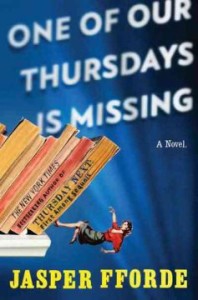
Jasper Fforde’s latest offering in the Thursday Next series is a metafictional tour de farce. The original Thursday — literary police Special Operations Agent (ret.) and the star of her own series of novels-with-novels — has disappeared, and it’s up to her fictional character to find her by impersonating the real Thursday. There’s a border dispute in BookWorld between the genres of Racy Novel and Women’s Fiction, and if Thursday doesn’t show up for the peace talks, war might ensue. Fforde sprinkles his story with characters and allusions from the classics and popular fiction, and makes liberal use of puns including setting up whole subplots just for a punch line. His style is uncategorizable and nearly indescribable, at least not in a way that makes any sense, but irresistibly entertaining and uniquely inventive. This sequel refers back to things that happened (or didn’t) in previous titles in the series, and it might help to start with the first installment, The Eyre Affair.
Reviewed by Faith
Tagged: Fantasy, Fiction, Humor, Literary fiction
A Discovery of Witches
by Deborah Harkness
[Book]
view/request
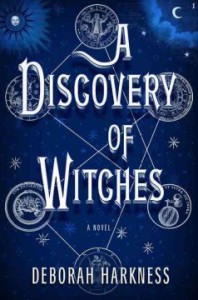
Witches and vampires for grownups. A more sophisticated world of fantasy, with academia, history and a love of books thrown in for good measure are wondefully devleoped in this debut by a history professor.
Diana Bishop has spent her life denying her heritage, as the last of a powerful family of witches. While doing historical research at Oxford, she meets Matthew Clairmont, a several century old vampire. One of the manuscripts that Diana requests at the Bodleian is under intense scrutiny by the community of witches, vampires and daemons, and may hold the secrets to the evolution of these uncooperative species. Soon, Diana and Matthew find themselves alienated from both communities. Great description and attention to detail, realistic characters — as much as vampires and witches can be. This is the first in a projected trilogy, and you won’t be able to wait for the sequel when you finish this book.
Reviewed by Molly
Tagged: Fantasy, Fiction, Paranormal
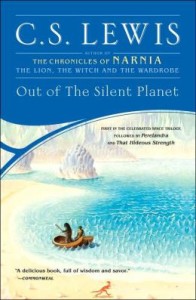
Out of the Silent Planet
by C.S. Lewis
[Book]
view/request
In this early work of science fiction (Out of the Silent Planet was first published in 1938) C.S. Lewis tells the story of a philology professor, much reminiscent of Lewis’s friend J.R.R Tolkien, who, while exploring a mysterious house in the English countryside, is kidnapped and brought to the mysterious planet of Malacandra aboard a strange space–going vehicle. The professor escapes his captors soon after they land, and he finds himself terrified in an unfamiliar world. His curiosity overcomes his fear, however, when he discovers that many of the native creatures possess the ability to speak and share a common tongue. During his time on Malacandra the professor learns much about the planet and its inhabitants, but even more about his own home, the Earth, and the place of human kind in the universe.
This is an engaging tale, characterized by a sense of wonder and enthusiasm which is too often lacking in newer works of speculative fiction. It is as much a fantasy story as it is science fiction, and with its exploration of the nature of good and evil and its Christian inspired themes it has some resemblance to Lewis’s more familiar Chronicles of Narnia, though it is a more serious, more adult book in many ways.
Out of the Silent Planet is a quick, enjoyable read, that provides much food for thought to those who want it, without weighing down those who would rather do without. It’s also the first book in a trilogy; those who enjoy it will want to continue with it’s successors Perelandra, and That Hideous Strength.
Reviewed by Ben
Tagged: Fantasy, Fiction, Science fiction
Room
by Emma Donoghue
[Book]
view/request
Having read some reviews of this book which described the harrowing situation of the two main characters, I wasn’t sure whether I wanted to read it or not. I’m glad I did though because the characters of Ma and Jack were so well developed and held my interest so thoroughly that I read this book almost non-stop during a two day period. Emma Donoghue has written a wonderful character driven novel which is absolutely a must read.
Reviewed by Susana
Tagged: Fiction, Literary fiction, Mother and child
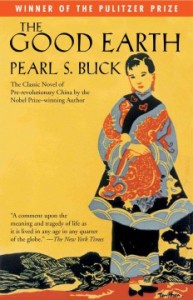
The Good Earth
by Pearl Buck
[Book]
view/request
Wang Lung, rising from humble Chinese farmer to wealthy landowner, gloried in the soil he worked. He held it above his family, even above his gods. But soon, between Wang Lung and the kindly soil that sustained him, came flood and drought, pestilence and revolution…
Through this one Chinese peasant and his children, Nobel Prize-winner Pearl S. Buck traces the whole cycle of life, its terrors, its passion, its persistent ambitions and its rewards. Her brilliant novel — beloved by millions of readers throughout the world — is a universal tale of the destiny of men.
Reviewed by Dylan
Tagged: China, Fiction, Historical fiction, Pulitzer Prize winner
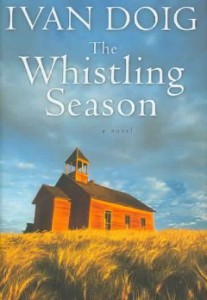
The Whistling Season
by Ivan Doig
[Book]
view/request
“Can’t cook but doesn’t bite.” So begins the newspaper ad offering the services of an “A-1 housekeeper, sound morals, exceptional disposition” that draws the hungry attention of widower Oliver Milliron in the fall of 1909. And so begins the unforgettable season that deposits the noncooking, nonbiting, ever-whistling Rose Llewellyn and her font-of-knowledge brother, Morris Morgan, in Marias Coulee along with a stamped of homesteaders drawn by the promise of the Big Ditch — a gargantuan irrigation project intended to make the Montana prairie bloom. When the schoolmarm runs off with an itinerant preacher, Morris is pressed into service, setting the stage for the “several kinds of education” — none of them of the textbook variety — Morris and Rose will bring to Oliver, his three sons, and the rambunctious students in the region’s one-room schoolhouse.
A paean to a vanished way of life and the eccentric individuals and idiosyncratic institutions that made it fertile, The Whistling Season is Ivan Doig at his evocative best.
Reviewed by Dylan
Tagged: Culinary fiction, Education, Families, Fiction, Frontier, Historical fiction, Western
Any Day Now: David Bowie
by Kevin Cann
[Book]
view/request
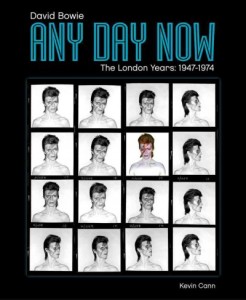
Any Day Now covers Bowie’s early life and the beginning phases of his exceptional musical career. This painstakingly assembled biography/chronology lists studio session dates and concert appearances, presents press clippings and handwritten letters and also provides a complete discography for the said period in time. Most impressive is the multitude of incredible photographs of the adventurous singer; each page is filled with striking images, large and small. It’s an interesting read and account of the rapidly progressing artist in both appearance and musical style.
Reviewed by Jason
Tagged: Biography, Music, Non-fiction
Rocannon’s World
by Ursula K. Le Guin
[Book]
view/request
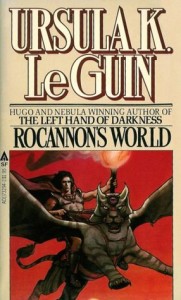
Ursula Le Guin’s first novel seamlessly blends science fiction and fantasy. Rocannon, an ethnologist, visits the planet Formalhaut II to study the native culture, and finds himself trapped when his ship is destroyed. In his adventures he rides on the back of giant winged cats, meets the various species inhabiting the planet, some of which have striking similarities to the men, elves, and dwarves of fantasy fiction, and must confront a mysterious presence in a cave. In Rocannon’s World, Le Guin explores the implications of space travel, faster than light communication, and the meeting of alien cultures. A powerful story, appropriate for fans of either genre.
Reviewed by Ben
Tagged: Fantasy, Fiction, Science fiction
Man Ray in Paris
by Erin C. Garcia
[Book]
view/request
We’ve recently been hit with a steady current of material spotlighting Americans residing among the Parisians in the 1920’s. Several fantastic books on the subject have been published this year along with the opening of Woody Allen’s new comedy Midnight in Paris.
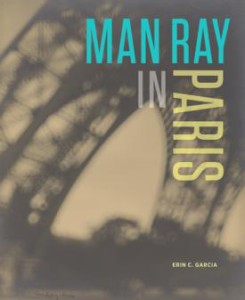
Paris in the 1920’s was a creative haven for many artists, critics, filmmakers and writers. Man Ray, who would not wish to be simply classified as a photographer (he considered himself a painter who also took photographs, made films and worked with sculpture and collage), came to France in 1921 and produced some of his most revered photographic work. Basing much of his craft on experimentation and dreamlike imagery, he aligned himself with artists in the Dada and Surrealist movements. In Erin C. Garcia’s book, we see portraits of Man Ray’s colleagues which include Jean Cocteau, Hans Arp, Salvador Dalí and Marcel Duchamp.
Man Ray in Paris provides many stunning photographic plates and also chronicles the artist’s stay in the City of Light.
Reviewed by Jason
Tagged: 1920s, Non-fiction, Paris, Photography
The Weird Sisters
by Eleanor Brown
[Book]
view/request
The first odd thing I noticed about this novel is that it’s told in the first person plural. It’s a clever and engaging device for sisters talking about themselves and each other, and kept me attentive to whose point of view I was reading as it shifted from the inside of a character’s head to one, two or three characters collectively observing another. The voice is opinionated, familiar, loyal, funny, and often jealous or spiteful as siblings are about each other. Not much happens (three adult sisters move home as their mother struggles with cancer; they find themselves to be more than they thought) but plot doesn’t much matter as the book is about personalities, family relationships, and how we evolve through involvement with others. A rich vein of Shakespeare runs through Weird Sisters in the naming of characters, the professor father’s constant quoting, and the cast of literary archetypes that inhabit these contemporary, believable women.
Reviewed by Faith
Tagged: Fiction, Women